MENU

Tag Archive: AI

  1. The Agency Edge: The Human Advantage

    Comments Off on The Agency Edge: The Human Advantage

    Emotional Intelligence: the Agency advantage AI can’t copy

    Emotional intelligence: the Intelligence AI Can’t Copy

    “The ability to deal with people is as purchasable a commodity as sugar or coffee and I will pay more for that ability than for any other under the sun.” (John D Rockefeller)

    An historic quote but we’d argue it’s more relevant than ever in agency life today.

    As we manage the staggering pace at which artificial intelligence is impacting the creative service world, we’re also seeing another intelligence move into the spotlight – Emotional Intelligence (EQ). As fast as we seek to automate everything in sight, agency leaders must remember that EQ will be the differentiator that sits behind an increasingly AI-driven offer.

    It’s EQ that sparks the understanding and creativity for a pitch winning idea.

    It’s EQ that comes to the fore when handling those angry client calls or the performance conversation you’ve been avoiding.

    It’s even EQ when you decide to do something different in the moment to get a new business pitch back on track and the rest of the team sits stunned because it didn’t happen in rehearsals.

    In short, Emotional Intelligence (EQ) is our ability to understand ourselves and others, make decisions with empathy and build meaningful and trusted stakeholder relationships.

    It’s these relationships that are central to agency success.  For example:

    • Trusted advice.  As AI streamlines many routine services, agencies are leaning more on their strategic counsel to differentiate. As this trend continues, the ability to establish trusted advisor client relationships using our EQ is more important than ever.
    • Leading and inspiring your team. Emotions drive people and people drive performance.  As competition for talent continues to grow, its managers and leaders who can best connect with, build trust, inspire and ultimately retain top talent who will thrive.  AI tools will not replace the human skills required to get the best from your teams – that’s EQ.  
    • EQ is earned and learned, not programmed…And it boosts your team’s well-being.  EQ provides the self-awareness and regulation to build resilience, manage stress and reframe challenges – allowing us to not just withstand adversity but learn and grow from it.  The best performing agency teams demonstrate high EQ.  
    • Sometimes, you’ve got to trust your gut – especially when hiring!  AI might be able to tell you a given candidate is the best fit for the job based on a set of criteria.  But when it comes to hiring decisions, how often does your gut tell you one thing while the paperwork says another – the former often proving to be correct! That’s EQ at work.

    So how can you develop EQ?

    The good news is that unlike our IQ (which is largely fixed), our EQ can be developed.  One of the fastest ways we’ve found to build it in agency teams is Insights Discovery — because it gives people a shared language for behaviour under pressure.

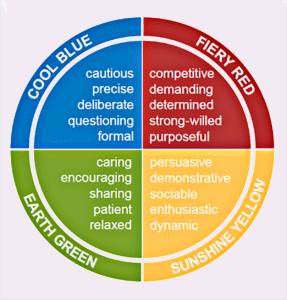
    It uses a simple but powerful four colour model to increase self-awareness, deepen our understanding of others and develop the skills to adapt our interactions for maximum success.

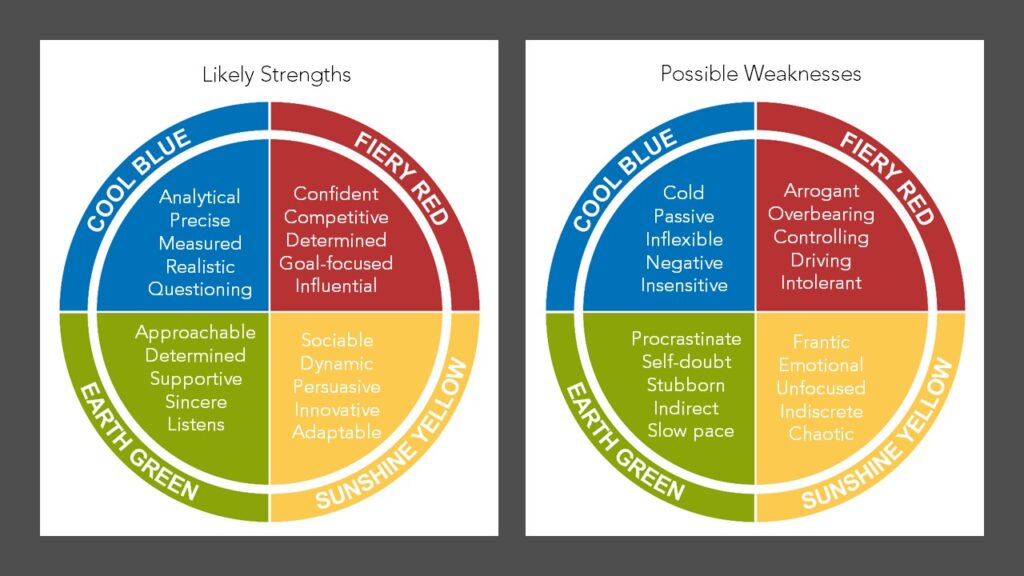
    Each colour energy reflects a set of behavioural traits. While we all have splashes of all four colour energies, what determines our behavioural and interaction preferences is how much of each energy we naturally possess.

    Insights Discovery and EQ - Emotional Intelligence

    Predominantly, we tend to display both the strengths and the potential weaknesses of our two most dominant colour energies.  The remaining two colour energies will show up occasionally but are less visible in general.

    Colour energies

    This insight is gold dust when it comes to developing our self-awareness and self-control – both essential for developing our EQ.

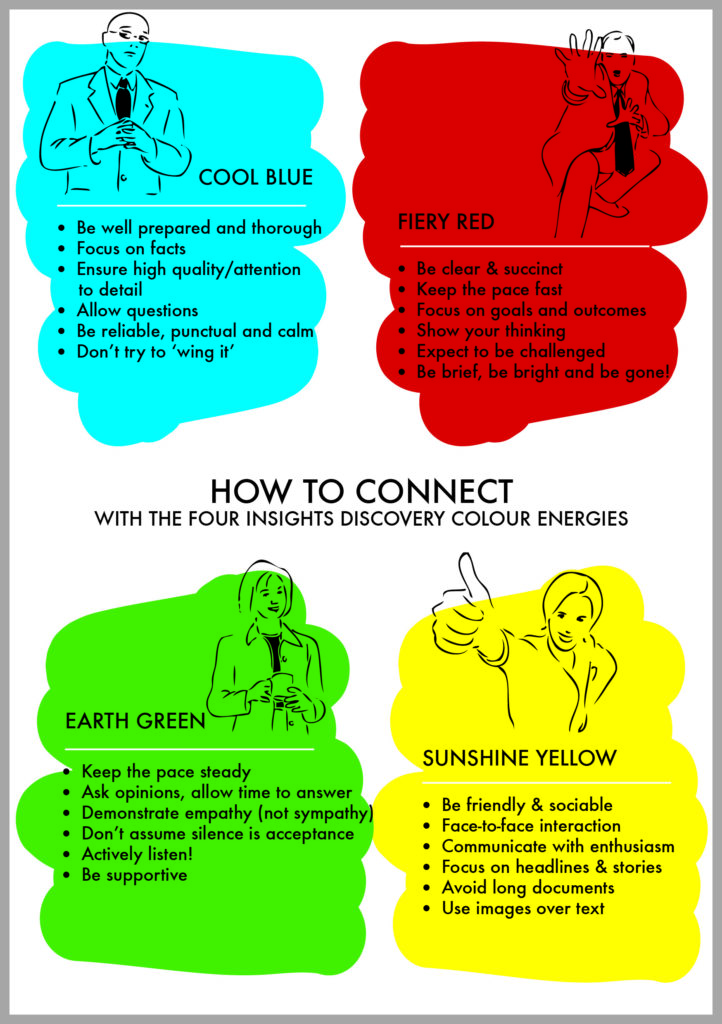
    Helpfully, we can then use the same tool to recognise the behavioural and communication preferences of others and find ways to adapt our interactions for greater success.  The graphic below indicates how best to connect with each colour energy.

    Emotional Intelligence. Insights Discovery colour energies

    So there you have it.  One powerful tool to help boost your EQ.  Give it a try with your teams and clients.  Identify their top two colour energies.  Then employ some of the corresponding tips to enhance your interactions (think managing, motivating, pitching, influencing and so on).        

    People buy people

    When it comes down to it, agencies are and will remain people businesses.  It’s your people who determine how good your offer is and how good the results are.  They determine the strength and depth of your client relationships and how engaged, motivated and inspired your teams are.  AI will undoubtedly continue to change the landscape at pace but it’s our EQ that will ultimately attract, engage and retain the clients.

    If you’d like to explore how to build more self-awareness and behavioural flexibility across your team, drop us a line at info@ambergroup.net.

    View our latests posts

  2. The Agency Edge: You’re the Boss

    Comments Off on The Agency Edge: You’re the Boss

    Is there a commercial blind spot in your agency?

    “PR people aren’t great with numbers,” is a comment we hear a lot when working with agencies but it’s one that always mystifies us. Surely a PR consultant that is commercially aware, from account executive upwards, is a better consultant?

    • Better positioned to manage and make decisions with clients by avoiding over service.
    • Better positioned to advise clients because they understand their business model.
    • Better positioned to make the leap from agency consultant to agency management.

    It’s about commercial consequences

    With agency teams working incredibly hard, the issue is that many people don’t naturally see the commercial consequences of the decisions they’re making in the moment.

    • “We’ll squeeze it in” becomes overtime, stress and rushed quality.
    • “Let’s keep them happy” becomes unrecoverable time.
    • “We’ll do it this once” becomes the new baseline.

    And it’s why commercial awareness is one of the most valuable leadership skills you can teach. Because when the team understand that every decision has a commercial implication, you get better choices – earlier.

    What changes when teams get it

    When people can see the commercial ripple-effect, three things usually shift fast:

    1) Pushback becomes easier (and less awkward).

    Because it’s no longer “I don’t want to.”

    It’s “Here’s the trade-off.”

    That’s a very different conversation with a client.

    2) Prioritisation gets sharper.

    People stop trying to do everything.

    They start protecting the work that matters and flagging the work that doesn’t.

    3) Capacity stops being an abstract concept.

    It becomes a shared responsibility, not an ops problem.

    And there’s a bonus that’s easy to overlook:

    If your people understand your commercial realities, they also become more commercially useful to your clients.

    Why most agencies struggle to train this (without boring everyone senseless)

    Commercial training often fails because it feels like finance. Spreadsheets. Definitions. Margin lectures.

    People nod. Then Monday arrives… and nothing changes. Because commercial awareness isn’t learned by being told. It’s learned by making decisions, feeling the consequences, and connecting cause and effect.

    Which is exactly why we built our new agency simulation game: You’re the Boss

    You’re the Boss is a fast-paced, team-based agency leadership simulation.
    Think Football Manager energy but for running an agency. 

    Teams make a series of decisions over several “quarters” of agency life. Choices about what type of new business to go for, staffing levels, quality and investment in your marketing, technology and staff well-being.

    For every decision, the game makes the commercial consequences visible. Just like real agency life.

    It’s designed for owners and leadership teams who want to create a shared commercial mindset across the agency — without turning it into a lecture.

    It also runs brilliantly as an away-day game for the whole agency to establish a grounding in commercial understanding that will have a positive impact across the agency immediately. 

    If you’d like a demo…

    If you’d like to see how You’re the Boss works — and the kinds of “aha” moments it reliably creates — email info@ambergroup.net to book a demo or find out more.

    agency commercial awareness simulation

    View our latests posts

  3. The Agency Edge: GEO is the new SEO

    Comments Off on The Agency Edge: GEO is the new SEO

    GEO is the land-grab of 2026. PR should lead it.

    The talk of the PR agency world is that people are quietly switching behaviours and it’s a huge opportunity for the industry to take responsibility for GenAI Engine Optimisation (GEO) for their clients.

    Instead of typing a query into Google, scanning results, clicking a few links and making up their own mind… more and more people are instead simply asking GenAI and accepting the first answer they see.

    That “ask-and-accept” habit is spreading fast and what is Gen AI relying on for those answers? At the moment, it’s overwhelmingly earned media coverage and open, readable, third-party content. 

    The big opportunity: earned coverage becomes the fuel for answers

    That is a huge opportunity for PR agencies and their clients, because it shifts the value of earned media from “reach” and “reputation” to “being the material the answer is built from.”

    Where AI gets its information from

    So, where do agencies need to place this earned media to appear in the answers of GenAI tools like ChatGPT? It varies by platform, but studies of sources used in AI answers keep surfacing the same clusters:

    • Wikipedia (baseline facts and definitions) 
    • Reddit and other community Q&A (real-world opinions, experiences, use cases) 
    • YouTube (especially when the content is easy to extract/understand with transcript in the description) 
    • Mainstream news / wire sources (for “what’s happening?” and credibility signals). Long live the press release! 
    • And the less obvious winners: comparison, review, and “best X for Y” list-style content — the stuff that helps a model answer intent-led questions quickly (including niche forums and specialist sites). 

    Where AI bots may struggle to find your website

    On the opposite side, it’s worth also considering where the AI bots aren’t finding its answers. Again, not universal, but very common:

    • Paywalls / logins / membership gates: if a bot can’t access the text, it can’t use it.
    • Bot blocking: a growing chunk of the web is actively choosing to block AI crawlers.
    • JavaScript-heavy sites: if key content is rendered client-side, some crawlers may only see a thin HTML shell.

    1) Reset the scoreboard

    These two client-friendly questions are a great place to start:

    • For a client’s priority topics, what does GenAI currently say about us and our competitors?
    • And what sources is it drawing on when it says it?

    2) Build the “answer landscape” for each client

    Pick the key topics that matter commercially for the client’s business (category, problems you solve, “best for…”, comparisons, pricing/value, trust/safety, implementation, ROI).
    Then map:

    • What questions people actually ask (not what we wish they asked)
    • Which outlets, communities and creators consistently show up
    • Where the client is missing — and why?

    3) Rebuild earned media around “machine-readable proof”

    This is the real land-grab.
    It means:

    • More specific stories (niche, specialist outlets, creator channels, communities)
    • More evidence (examples, numbers, clarity, third-party validation)
    • More formats that answer intent (“X vs Y”, “best for…”, “how to choose”, “what to avoid”)

    4) Fix owned content so it’s usable by both humans and machines

    Most brand content is still written like a brochure.
    Reformat it into:

    • Comparison pages and decision guides
    • “Best for…” scenario content
    • FAQ hubs that mirror customer language
    • Structured pages with clean headings and quotable lines

    And make sure you’re not accidentally hiding it behind technical blockers.

    5) Treat video as an “answer” asset, not just brand content

    Publishers are using video more and more. For clients, this means spokespeople and subject experts need to be confident in podcast/video formats and the content needs to be packaged so it can be understood and reused (clear titles, descriptions, transcripts where appropriate, strong “what it is / who it’s for / why it matters” framing). 

    6) Get your team ready to deliver (this is a capability shift)

    Someone in the agency needs to own GEO. They can be helping clients and their agency teams:

    • Monitoring how clients appear in GenAI answers over time
    • Updating media strategy and target lists to include creators + communities + specialist sources
    • Coaching clients on content formats that win in an answer-first world
    • Light governance for accuracy and corrections (because AI summaries can be confidently wrong!) 

    This is a rare moment for PR agencies to lead the creative services world.

    The rulebook is changing, the measurement is shifting. If you get your clients visible inside Gen AI answers now, you’ll be hard to dislodge later.

    And if you’d like a practical way to kick-start it, we’ve created GEO Training For Agencies at The Amber Group — designed to help agency teams get their people ready to deliver.

    PR agencies leading GenAI Engine Optimisation by shaping earned media sources used in AI-generated answers

    View our latests posts

  4. The Agency Edge: YOUR AI CHALLENGE

    Comments Off on The Agency Edge: YOUR AI CHALLENGE

    Fast but flat: Is your agency team becoming over reliant on AI?

    “The team’s using AI for everything… but I can’t always see where the thinking is.”
     
    That’s the tension we’re hearing from a lot of agency leaders right now. 
     
    Six months ago, the question was, “Should we tell clients we’re using AI?” Now, everyone’s using it. It’s in brainstorms. It’s in research. It’s in first drafts. It’s in the templates your teams are quietly building for themselves. And that’s not a bad thing. In fact, it’s essential. The risk isn’t that AI is in the work but that your people start to remove their thinking from the work.

    When speed quietly squeezes out judgement

    Under pressure, AI feels like a gift. Short deadline. Tricky brief. Tuesday afternoon brain-fog. You paste in a few bullet points and get a decent first draft. You tidy it, send it and move on.

    Individually, that doesn’t feel dangerous. But scaled across a whole team, week after week, something starts to happen. Pitches initially feel polished… but somehow lack a point of view or clients stop saying, “That’s such a you idea.”

    The danger here is that alongside saving time your people are quietly outsourcing the thing your clients value the most: Your critical thinking, your judgment and taste!

    AI is brilliant at tasks. Your value is in choices.

    Used well, AI should absolutely be doing more heavy lifting on repetitive tasks like summarising long documents and identifying themes, turning messy brainstorm outputs into structured options or drafting first version copy or plans.
     
    But only your people can decide which insight actually matters to this client, right now, or say, “This looks good, but it’s not good enough yet” and push a bland idea until it’s sharp, brave and still on-brand.
     
    It’s here where many agency leaders are seeing that gap. How to use AI in a more practical and consistent way without switching off the brain.

    From ‘playing with prompts’ to a shared way of working

    Most agency teams we work with are already experimenting with prompts. A few people have their own hacks. Some have built little internal libraries.

    What’s often missing is a simple, shared way to:

    When teams have that kind of framework, the AI speed advantage stays but it also builds-in human critical thinking, so that the agency edge remains.
     
    It’s why we are helping agencies train their people to use consistent AI Prompting methods like COCO. It stands for:

    C – Character: Tell the AI the expert it should pretend to be. For example, a B2B Professional copywriter. It helps the AI draw on specific knowledge areas.

    O – Objective: What you want to achieve. The AI needs to understand your goal.

    C – Context: What else does the AI need to know? All the essential information. Upload examples of what you want and don’t want. Detail matters here!

    O – Output: What should it look like? Are there any rules or limits? Example: Each headline must be under 60 characters. Use no buzzwords. Keep the tone urgent but credible.

    Now before you push Go, one final instruction:

    “Do not guess. Ask me anything else you would find helpful to complete this task better.”

    And then answer its questions. It helps minimise hallucinations and gives the AI a chance to ask for any important information that you may have missed. 

    Credit to Anna Carina Berkman (Architect Anna) for the COCO approach. It’s effective, easy to use and remember!

    A quick AI sense-check for your own agency

    Is your agency still in enthusiastic adoption or now in the phase of implementing AI with thoughtful practice?
     
    The agencies getting ahead aren’t banning AI tools or writing long policies. They’re doing two things:
     
    1. Resetting expectations – being explicit that AI is there to amplify their people’s thinking, not replace it.
    2. Giving teams practical skills – short, hands-on training so people know how to brief, stack and stress-test AI, without losing their own judgement.
     
    If you’re already feeling that slight drop in sharpness – that sense that work is faster but somehow flatter – it might be time to look at how your people are working with AI.
     
    And if you’d like a practical session to help your team build that “human-first, AI-smart” way of working, get in touch. It’s an area where we’re spending a lot of training time with agencies right now.

    View our latests posts

  5. The Agency Edge: CREATING A GROWTH MINDSET

    Comments Off on The Agency Edge: CREATING A GROWTH MINDSET

    Don’t sell me something, solve me something!

    SellingIt’s the thing most people didn’t join the creative industry to do.  Yet it’s now one of the most important capabilities an agency can build.  But here’s the twist: the agencies that are growing fastest aren’t “selling” in the old-school sense.  They’re ‘solving’.  They’re spotting opportunities early, shaping client thinking and guiding budgets before someone else gets there first.  And it isn’t by chance.  There’s a method to it.

    The only constant is change.

    The ability to sell to clients confidently and consultatively has never been more important. There’s the steady shift away from retainers to project-based relationships. More projects mean more selling. Competition is also fiercer. More people trying to steal your lunch expedites the need to unlock opportunities and secure budgets before someone else does. And then there’s the AI factor. With the prospect of many agency tasks being automated, the need to sell-in and charge for higher value work is only going to intensify.

    “My team are great at delivery, I just wish they’d sell more!”

    If you’ve ever said this, you’re in good company.  Your Account Managers and Account Directors are perfectly placed to spot organic growth opportunities. They hear client frustrations first, understand stakeholder dynamics and see where communication can move the needle.  But they often don’t act—and it’s rarely laziness. It’s usually down to a combination of reasons:

    • They don’t see it as part of their role, delivery feels like the priority.
    • They see selling as confrontational and don’t want to jeopardise client trust.
    • They don’t feel personally motivated – selling equals more work, not more reward.
    • They lack the skills and confidence or are simply unsure where to start.

    This creates a huge missed opportunity.  The growth potential sitting quietly inside existing relationships.

    Five steps that create a selling culture

    After decades training and coaching creative agencies, we see five levers that consistently transform teams from “reluctant sellers” into confident growth drivers:

    1. Mindset – This is where the shift begins. 

    Selling shouldn’t be viewed negatively—it’s about providing solutions. Creative agencies deliver significant value to clients that often far exceeds their fees. By re-framing selling as helping clients solve challenges and realise value, teams start to move past psychological barriers.

    2. Motivation – People sell more when there’s something in it for them. 

    People are different, so make organic growth meaningful by linking it to as many personal motivators as possible.  This includes extrinsic factors such as performance objectives, promotion and bonuses as well as intrinsic factors such as recognition programmes, shout outs and awards.  When growth is aligned with personal motivations, behaviour changes fast.

    3. Knowledge – Teams will only sell what they understand.

    Give everyone a simple, accessible overview of what the agency offers and why clients would buy those services.  This doesn’t mean everyone becomes a technical expert. It means everyone becomes confident enough to ask the right questions, spot opportunities and open the door.

    4. Skills – Every interaction is a sales opportunity

    Consultative selling is a skill and a learnable one.  We train a lot of agency teams in this area and one tool that particularly resonates is S.P.I.N.  No, not the PR type.  We’re talking about a well proven consultative selling methodology consisting of four steps:

    • Situation – Use good, open questions to establish facts about the client’s situation and identify potential problems or opportunities.  ‘How’s business,’ is always a good place to start!
    • Problem – Focus the client on a specific problem or opportunity arising from the conversation that your product or service can address.  For example, regularly losing out to a competitor in a particular market.
    • Implication – Don’t jump straight to a solution.  Instead, help the client explore the impact of not solving the problem or not capitalising on the opportunity.  Missed revenue, lost market share, slower growth, internal friction and so on. This creates urgency and tangibility.
    • Need – You have now created a need for YOUR solution, which capitalises on the opportunity or solves the problem.    

    When teams are properly trained to unlock opportunities, they stop “pitching” and start consultinggrowth then becomes more natural.

    5. Measurement – What gets measured gets managed.

    Set targets that are realistic, motivating and meaningful.  Coach people along the way.  Celebrate wins, no matter the size.  You’ll start to see confidence turn into momentum and momentum into revenue.

    Organic is best…

    While winning new (transitional) business is important, organic growth opportunities can be quicker and easier to convert and hence more profitable.  Some people in your team will take to selling naturally. Others will take a little coaching.  But when you embed these five steps you create a culture where consultative selling becomes second nature.  Your agency stops waiting for briefs and starts shaping them. 

    If you’d like help establishing a sales culture across your team or perhaps a consultative selling workshop that gives your people the tools, structure and confidence to sell, do get in touch. We’d love to support your next stage of growth.

    consultative-selling-creative-agencies

    View our latests posts